
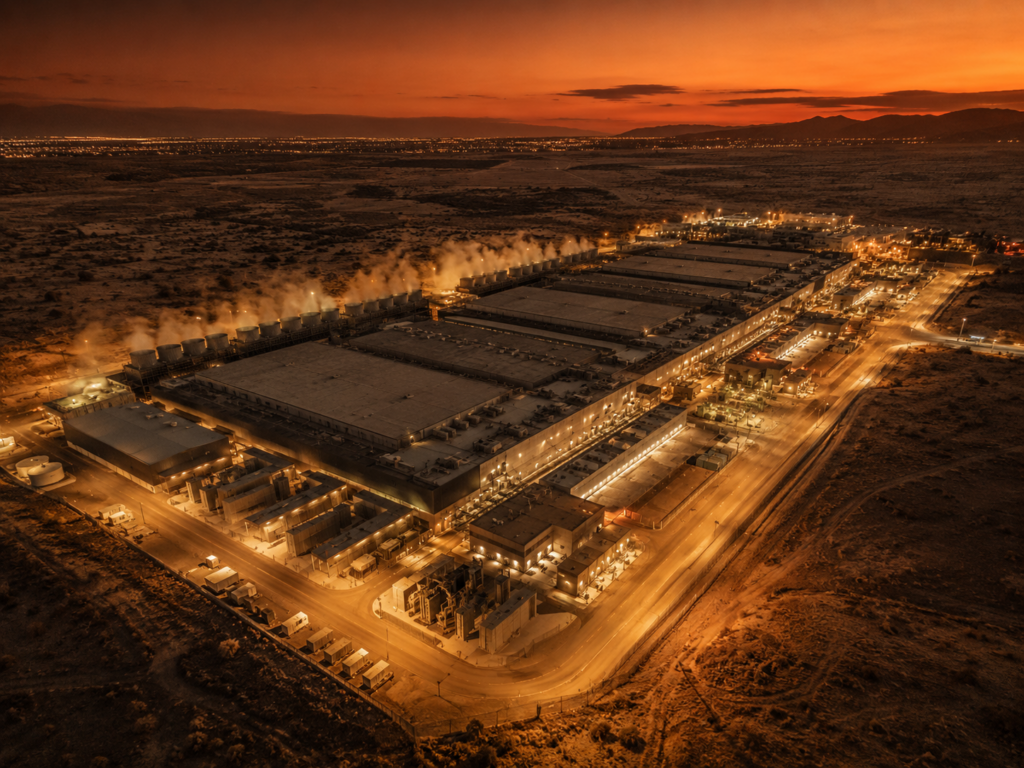
Everyone is watching the AI model race. While frontier models and geopolitical intrigue make the headlines, the more interesting competition is happening in the infrastructure layer underneath it.
On June 15, 2026, Schneider Electric and Foxconn announced a strategic collaboration to co-develop and scale next-generation AI data center infrastructure. The partnership combines Foxconn’s manufacturing and AI server expertise with Schneider Electric’s power management and cooling technologies, with production of jointly developed solutions expected to begin later this year. The announcement received a fraction of the coverage that Apple-Google or Anthropic-TCS generated.
That is a mistake.
This deal addresses a constraint that will determine whether the AI era delivers on its promise or stalls out — and it is structured in a way that reveals something important about how the most consequential partnerships of this decade are being built.
THE BOTTLENECK NOBODY WANTS TO TALK ABOUT
The dominant narrative in AI is about chips and models. The actual constraint is electrons and heat.
AI infrastructure spending is running more than 40% higher year-over-year in 2026. Estimates suggest that meeting global compute requirements through 2030 may require close to $7 trillion in data center investment. The physical infrastructure that supports all of it — power distribution, thermal management, deployment speed — is under pressure that no frontier model improvement will relieve.
Electrical equipment represents under 10% of total data center cost and 100% of the bottleneck. Transformer lead times that ran 24–30 months before 2020 now stretch to five years in some cases. Average rack density has grown from 6 kW nine years ago to 16 kW today — but AI workloads demand 30–40 kW or more, and only a fraction of operators are currently prepared to support that requirement. The gap between what AI needs and what the infrastructure layer can currently deliver is not a secondary problem. It is the binding constraint on the pace of AI deployment at scale.
This is the problem Foxconn and Schneider Electric are structuring themselves to solve.
WHAT EACH PARTY BRINGS — AND WHY IT CANNOT BE REPLICATED
In The New Rules of Partnerships, I argue that the most durable partnerships are built on genuine asymmetry: each partner brings something the other cannot build alone on any commercially viable timeline. This deal has that quality clearly.
Foxconn is the world’s largest electronics manufacturer — Fortune Global 500, rank 28, approximately $260 billion in revenue in 2025, more than 40% market share in electronics manufacturing services, operating over 240 campuses across 24 countries. It brings advanced compute platforms, AI rack integration, and manufacturing scale that no new entrant could replicate on a relevant timeline. Schneider Electric brings the other half of the stack — power systems, cooling, energy management, and the closed-loop automation software that makes AI infrastructure operate efficiently at scale.
Neither party can replicate what the other has. Schneider has spent decades building expertise in energy management and power distribution that no manufacturer can compress into a three-year build program. Foxconn has manufacturing scale and AI rack integration capability that no energy technology company can match. The asymmetry is real, it is structural, and it is the foundation of a sound partnership thesis.
What the deal adds beyond asset complementarity is speed. The companies are creating repeatable blueprints that organizations can use to build AI capacity more rapidly without incurring the energy and construction costs that currently constrain deployment. Standardised reference architectures, modular power and cooling skids, pre-engineered infrastructure systems — the entire logic of the collaboration is designed to compress deployment timelines and make AI data center builds replicable across regions. That is not primarily an engineering objective. It is a commercial strategy.
THE COMPETITIVE LOGIC — WHAT THIS DOES TO THE LANDSCAPE
The Foxconn-Schneider collaboration changes the competitive landscape for turnkey AI data center providers in three ways.
First, it raises the floor on what a credible infrastructure offering requires. Any provider competing at scale for AI data center mandates now faces a benchmark that integrates compute, power, cooling, and energy orchestration in a single coordinated ecosystem. Fragmented offerings — best-of-breed components assembled by the customer — become a harder sell when a coordinated alternative exists with Foxconn’s manufacturing muscle and Schneider’s energy intelligence behind it. The integrated stack raises switching costs and makes the total offering stickier with customers who prioritize deployment speed and operational predictability over theoretical component optimization.
Second, it accelerates the vertical integration dynamic that has been developing across the AI infrastructure market. Microsoft, Google, and Amazon have been building proprietary data center designs and partnering deeply with energy providers. The Foxconn-Schneider collaboration extends that logic into the contract manufacturing and infrastructure supply chain. The implication for independent data center operators, colocation providers, and enterprise infrastructure teams is that the gap between what they can build independently and what a well-partnered competitor can deliver will widen, not narrow.
Third, it puts governance at the center of the value proposition in a way that most partnership announcements obscure. Closed-loop energy optimization requires deep integration between Foxconn’s hardware systems and Schneider’s software and energy management layer. That integration cannot be achieved through a loose commercial arrangement. It requires co-development processes, shared IP frameworks, and decision rights worked out at the partnership design stage. The companies have described what they intend to build. The governance architecture that makes it durable — who owns the jointly developed reference architectures, how revenue is attributed across integrated solutions, how the partnership resolves conflicts when hardware roadmaps and energy management roadmaps diverge — none of that is visible in the public announcement.
This is the pattern that runs through every major infrastructure partnership I have seen at scale. The announcement describes the commercial logic. The governance architecture determines whether it delivers.
WHAT A PRACTITIONER ASKS
Three questions determine whether this deal becomes a market-defining infrastructure platform or a well-structured collaboration that underperforms its potential.
The first is standards openness versus proprietary lock-in. The collaboration’s stated value is repeatable blueprints and standardized design frameworks. But who controls those standards? If the reference architectures are open enough that other compute and energy management vendors can participate, the ecosystem grows and the standard becomes the market. If the architectures are proprietary, the collaboration creates a strong but bounded offering — valuable for customers willing to commit to the Foxconn-Schneider stack, but limited in its ability to define the industry standard. The answer to this question will determine the ceiling on the deal’s commercial impact.
The second is equipment versus services. The announced scope is co-developed infrastructure solutions — hardware, architectures, deployment systems. The more durable commercial model converts those deployments into ongoing energy optimization, performance monitoring, predictive maintenance, and continuous improvement across deployed infrastructure. The organizations that build durable positions in AI infrastructure will be those that convert one-time infrastructure deployments into ongoing service relationships. Whether this collaboration is structured to enable that transition — or whether it stays at the equipment and architecture layer — will determine its long-term commercial value.
The third is geographic execution priority. Foxconn operates over 240 campuses across 24 countries. Schneider Electric’s energy management capabilities span every major market. The collaboration has, in principle, global reach. But AI infrastructure build-out is happening at very different speeds in different regions — the US, Europe, the Middle East, and Southeast Asia all have different power grid situations, regulatory frameworks, and customer readiness profiles. Which markets the two companies prioritize first, and whether those choices are made jointly with aligned commercial incentives or independently with potential for conflict, will tell you a great deal about how tightly integrated the partnership governance actually is.
THE BOOK THESIS IN THE INFRASTRUCTURE LAYER
In The New Rules of Partnerships, I argue that in the AI era no organization can build the full stack it needs on the timeline the market demands. The competitive unit is no longer the firm — it is the ecosystem.
Foxconn and Schneider Electric are, in their own infrastructure domain, a precise illustration of that thesis. Foxconn cannot build energy management expertise on a timeline that matters. Schneider Electric cannot build AI server manufacturing capability and global electronics supply chain reach. The AI data center build-out that the next decade requires cannot happen at scale without both.
What makes this deal worth watching closely — beyond its immediate commercial logic — is what it signals about where the AI infrastructure competition is actually happening. The model race is visible and well covered. The infrastructure race is quieter, more capital-intensive, and ultimately more determinative of which organisations can scale AI deployments and which ones stay constrained by power, cooling, and deployment bottlenecks that no chip improvement will solve.
The companies that understand this — and structure their partnerships accordingly — will define the physical layer of the AI era. The Foxconn-Schneider collaboration is one of the clearest signals yet that the most capable players understand exactly where the leverage sits.
The announcement is the easy part. Watch the governance.
Randy McGraw is the founder of M2 Ventures and the author of The New Rules of Partnerships. He has been the lead day-to-day architect of more than $2.3 billion in commercial partnerships and joint ventures across Japan, ASEAN, and the US. M2 Ventures advises corporate clients on partnership architecture, negotiation, and governance across APAC.